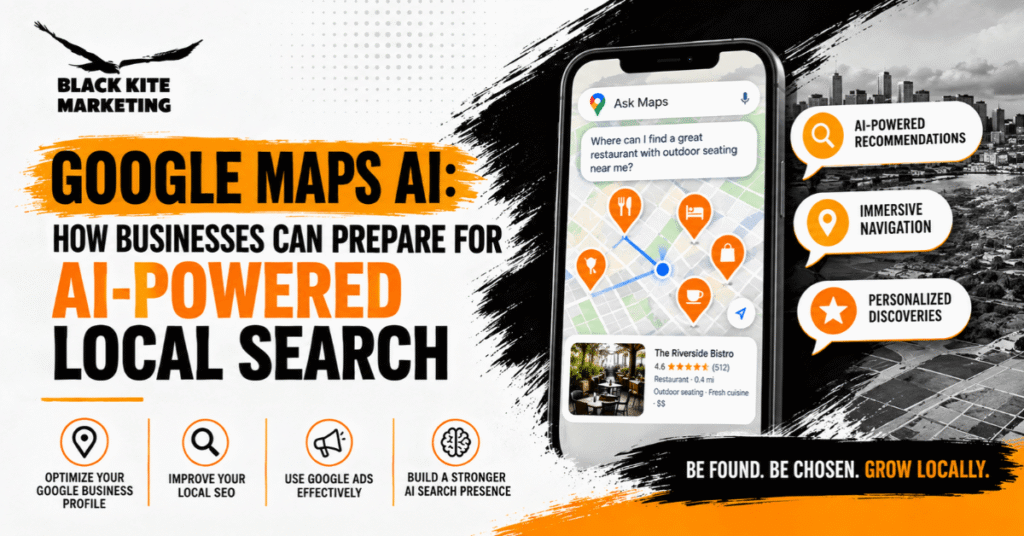
Google Maps has always been one of the most important platforms for businesses that depend on local customers. But with the new Google Maps AI features the platform is changing from a tool people use to find an address into a platform people can use to ask questions, discover businesses, compare options, plan trips and make decisions.
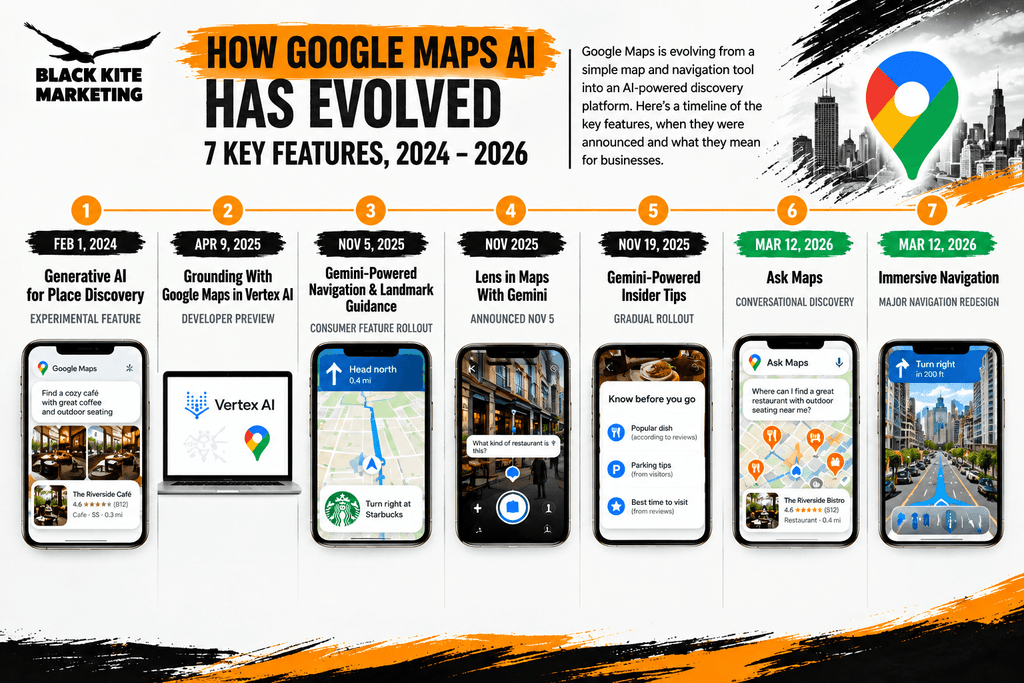
Timeline: How Google Maps Is Evolving With AI (2024–2026)
Google has been steadily integrating generative AI and Gemini into Google Maps, changing how people discover businesses, explore neighborhoods and navigate to destinations. The following timeline highlights the major milestones and what each means for local businesses and marketers.
1. Feb 1, 2024 – Generative AI for Place Discovery
Early experiment with conversational recommendations
Google introduced an experimental generative AI experience that helped users discover places based on detailed requests, using information about locations, photos, ratings and reviews. It initially rolled out to select U.S. Local Guides.
Marketing significance: This established an early version of conversational local discovery, where a business’s characteristics and customer reviews could help it match specific user needs.
2. April 9, 2025 Grounding With Google Maps in Vertex AI
Developer preview announced
Google announced an experimental capability that lets developers ground AI-generated answers in Google Maps location data. It initially provided access to information about more than 20 million U.S. places. On July 23, 2025, Google expanded the offering into preview across most regions globally.
Marketing significance: Travel companies, real estate platforms and other businesses can build AI assistants that answer location-specific questions using current place information, nearby amenities and reviews.
3. Nov 5, 2025 – Gemini-Powered Navigation and Landmark Guidance
Consumer feature rollout announced
Google announced Gemini-powered conversational navigation, allowing drivers to ask questions, find places along their route, check for EV chargers and perform certain tasks hands-free. Google also introduced landmark-based directions, using recognizable places such as restaurants and gas stations to make navigation more intuitive. Proactive traffic alerts were also announced.
Marketing significance: Businesses should maintain accurate locations, entrances, hours and visual information so customers can find and recognize them more easily when navigating nearby.
4. Nov 2025 – Lens in Maps With Gemini
Announced Nov 5; gradual rollout planned later that month
Google announced a feature that combines camera-based place recognition with Gemini. Users can point their phones at restaurants, cafés, shops or landmarks and ask questions about what they see, including what a place is known for or what its atmosphere is like.
Marketing significance: Accurate business details, authentic photos and informative reviews help provide useful context when people evaluate places visually.
5. Nov 19, 2025 – Gemini-Powered Insider Tips
Announced with a gradual rollout
Google announced AI-generated “know before you go” tips for places, drawing on reviews and other online information to surface practical insights, such as parking advice, reservation tips and popular items. An updated Explore tab also began rolling out to help people discover trending nearby places.
Marketing significance: Detailed, honest reviews and accurate information about amenities, reservations and customer experiences can help people evaluate a business before visiting.
6. Mar 12, 2026 – Ask Maps
New conversational discovery experience announced
Google introduced Ask Maps, allowing users to ask complex questions about places and receive conversational answers and personalized recommendations. Google says it draws on information about more than 300 million places and contributions from its Maps community. The initial rollout began in the U.S. and India on Android and iOS.
Marketing significance: Businesses should communicate the specific services, products, attributes and experiences that distinguish them—not just their primary category and location.
7. Mar 12, 2026 – Immersive Navigation
Major navigation redesign announced
Announced on the same day as Ask Maps, Immersive Navigation adds a more detailed 3D view, clearer road guidance, route trade-offs and additional help with parking and destination entrances. Google said availability would expand over the following months to eligible devices and supported in-car platforms.
Marketing significance: Keep storefront photos, location information and entrance details accurate. Businesses should not, however, assume that the 3D navigation experience automatically provides them with a new advertising placement.
For local businesses, this represents an important shift.
Someone no longer has to search for exactly what your business is called—or even use the traditional keywords associated with your industry. Instead, they can ask Google something like:
“Where can I take a client for a quiet lunch with good vegetarian options?”
Or:
“What’s a family-friendly hotel with a pool near the beach?”
Or:
“Where can I buy a leather jacket nearby?”
The opportunity for businesses is to make sure Google has enough accurate, detailed information to understand what your business offers, who it serves and what situations it is relevant to.
Here’s what the new Google Maps AI features mean for businesses and how marketers can prepare.
What Is Google Maps AI?
Google Maps AI refers to the growing collection of Gemini-powered capabilities Google is adding to Maps.
The most important development for marketers is Ask Maps.
Google describes Ask Maps as a conversational experience that can answer complex, real-world questions about places. Rather than entering a traditional keyword search, users can ask questions in natural language and continue the conversation with follow-up questions.
For example, a user can ask:
- “What’s fun to do this weekend within a 15-minute drive?”
- “Where can I meet my friends somewhere quiet with good food?”
- “Where can I get a charger without having to sit down for coffee?”
- “What are some good stops along my road trip?”
- “Where can I find a restaurant with vegan options near my route?”
Google says Ask Maps can draw on information from hundreds of millions of places and reviews from its Maps community. Results can also be personalized based on information such as places a user has searched for or saved.
That changes the nature of local search.
From keywords to context
Traditional local SEO has often focused on searches such as:
“Italian restaurant Melville”
AI-powered Maps can understand a much more complicated request:
“Where can I take clients for a quiet Italian lunch in Melville where we can actually talk?”
The second search contains multiple concepts:
- Location
- Cuisine
- Meal
- Atmosphere
- Business purpose
- User preference
Google’s AI is designed to understand these types of natural-language requests and connect them with places that may satisfy the combination of needs.
That means businesses need to think beyond individual keywords and start thinking about the contexts in which customers choose them.
What Is Immersive Navigation?
Ask Maps isn’t the only major change coming to Google Maps.
Google’s Immersive Navigation brings a more detailed 3D representation of the environment into navigation. Google says Gemini analyzes Street View imagery and aerial photos to help Maps understand buildings, terrain, landmarks, medians and other elements along a route.
The experience can also show things such as:
- Buildings and surrounding terrain
- Traffic lights
- Crosswalks
- Stop signs
- Lanes
- Landmarks
- Parking
- Building entrances
- The side of the street where a destination is located
This matters to businesses because the physical environment surrounding a business is becoming more important to the digital discovery experience.
Google has also introduced landmark-based navigation, which can use recognizable businesses and other landmarks when providing directions. Google says Gemini can analyze information about places and Street View imagery to identify useful landmarks.
A business therefore isn’t represented only by its name, address and phone number. Its physical location, surrounding environment and visual presence can also become part of how people experience the destination.
Note: While you cannot directly edit the 3D models which are entirely AI generated by Google you can optimize the underlying data and photos Google’s AI uses. Manage your Google Business Profile by uploading high-quality photos that accurately reflect your name, address, storefront, signage and entrance. This gives Google’s AI verified data to build context.
Why Google Maps AI Matters for Local Businesses
The biggest strategic change isn’t simply that Maps has AI.
It’s that the search interface is becoming conversational.
Google’s own Business Profile documentation says local ranking is primarily influenced by relevance, distance and prominence. Google also recommends complete business information, accurate hours, appropriate categories, attributes, reviews, photos and other information to help Google understand and present a business.
That becomes even more important when customers stop searching with simple keywords.
Businesses need to provide Google with a comprehensive narrative of:
What you are + where you are + what you offer + who you serve + what makes you different + what customers experience.
That information can come from several sources.
Google says business information can be compiled from the official website, Business Profile information, customer contributions, photos, reviews, third-party data and other sources.
In other words, your website and Google Business Profile should not be treated as two completely separate marketing channels.
They should tell a consistent story about your business.
Google Maps AI Marketing Opportunities by Industry
Different industries can take advantage of these changes in different ways.
1. Hospitality & Tourism
Hotels, resorts, attractions, tour operators and other travel businesses are particularly well positioned for conversational Maps searches.
A traveler may not simply ask:
“Hotels near me.”
They may ask:
“What’s a comfortable hotel near the beach with a pool that’s good for families?”
Or:
“I’m spending three days in the area. What should I do and where should I stay?”
Google has specifically demonstrated Ask Maps handling multi-stop trip planning and recommendations along routes.
Marketing opportunities
Hotels and attractions should create content describing experiences rather than simply listing amenities.
Instead of:
“Hotel with pool, restaurant and fitness center.”
Consider content that explains:
“Our family-friendly hotel features a heated outdoor pool, on-site dining and convenient access to the area’s most popular attractions.”
Businesses should also make sure applicable Business Profile attributes are complete.
Google says attributes can appear on Search, Maps and other Google platforms and can help businesses appear for searches involving those attributes.
Action items
- Update hotel and attraction descriptions.
- Keep Business Profile attributes accurate.
- Publish high-quality interior, exterior and amenity photos.
- Create location-specific travel content.
- Explain proximity to major attractions.
- Develop content around different traveler needs.
- Keep hours and seasonal information current.
The goal is to give Google’s systems enough context to understand when your business is the right stop for a particular traveler.
2. Restaurants, Cafés & Food Businesses
Restaurants may have some of the biggest opportunities because food searches are naturally experiential.
A customer may ask:
“What’s a quiet coffee shop where I can work for a few hours?”
Or:
“Where can I get a quick healthy dinner nearby?”
Or:
“What’s a lively restaurant that’s good for a birthday?”
Those searches go well beyond cuisine and location.
Marketing opportunities
Restaurants should clearly communicate:
- Cuisine
- Price range
- Atmosphere
- Dining options
- Dietary options
- Outdoor seating
- Parking
- Hours
- Popular dishes
- Group dining
- Family friendliness
- Accessibility
- Takeout and delivery options
Google’s Business Profile documentation specifically identifies attributes such as outdoor seating and Wi-Fi as information businesses can provide.
Restaurants should also maintain accurate menu information on their websites.
Don’t neglect structured data
Google’s LocalBusiness structured-data documentation supports properties such as menu, servesCuisine, priceRange, hours, address and geographic coordinates.
Reviews become even more valuable
Customer reviews can provide contextual information about the actual experience at a business.
A review that says:
“Great quiet place for a business lunch, and they have several vegetarian options.”
communicates considerably more context than a review that simply says:
“Great restaurant.”
Businesses should never manufacture or manipulate reviews, but they can encourage customers to provide honest, detailed feedback about their actual experience.
Google says Maps uses reviews and other user contributions as part of the information available about places, while its systems also use reviews and other account information for personalized AI responses.
3. Retail
Retail businesses have another important advantage: products can become part of local discovery.
A consumer may search:
“Where can I buy a leather jacket near me?”
Rather than simply finding a category of stores, the ideal experience is to discover a nearby location that actually carries what they want.
Google already supports local inventory information through Merchant Center.
Local inventory ads and free local listings allow eligible retailers to showcase products available at physical stores to nearby shoppers.
Action items for retailers
- Connect physical locations to Merchant Center.
- Maintain accurate product feeds.
- Keep inventory information current.
- Use appropriate Business Profile categories and attributes.
- Upload high-quality product and storefront photography.
- Maintain accurate hours.
- Use location assets in Google Ads.
This creates a stronger connection between what a consumer wants and where they can physically get it.
4. Healthcare Practices
Healthcare businesses can also benefit from conversational local discovery.
A patient may search for:
“Where can I find a podiatrist near me who treats heel pain?”
Or:
“What podiatrist near Queens treats sports injuries?”
A practice should therefore clearly explain its specialties, services, conditions treated, locations, insurance information where appropriate, accessibility and patient experience.
For medical businesses, accuracy is particularly important. Content should be written for patients first and should clearly distinguish general educational information from professional medical advice.
Action items
- Create dedicated service pages.
- Clearly identify providers and specialties.
- Maintain accurate Business Profile information.
- Include relevant accessibility and appointment information.
- Keep office hours current.
- Use appropriate LocalBusiness structured data.
- Develop useful condition- and service-specific educational content.
The objective isn’t to stuff medical keywords into a page. It’s to make the practice’s capabilities understandable to both people and search systems.
5. Professional Services
Law firms, accountants, marketing agencies, financial professionals and other professional-service businesses can also benefit from conversational discovery.
For example:
“Who can help a small business in Long Island improve its Google visibility?”
is fundamentally different from:
“marketing agency Long Island.”
The first query expresses a problem.
That means service businesses should create content around problems, situations and outcomes, not only service names.
For example:
- “How much does local SEO cost for a small business?”
- “How can a restaurant get more customers from Google Maps?”
- “What should a Long Island business do if its Google Business Profile isn’t ranking?”
- “How can a local business prepare for AI search?”
This approach also creates opportunities beyond Maps because the same conversational content can support traditional Google Search, AI-powered search experiences and other discovery surfaces.
6. Entertainment, Attractions & Experiences
Entertainment businesses should focus heavily on experiential language.
A museum, bowling alley, theater, attraction or activity venue could be relevant to searches such as:
“What can I do with kids on a rainy Saturday?”
or:
“What’s something fun to do with friends tonight?”
This means businesses should describe experiences, audiences and circumstances.
Instead of simply saying:
“Indoor entertainment center.”
a business could explain the actual experience it provides, such as activities for families, groups, birthdays or rainy-day outings—provided those descriptions accurately reflect the business.
7. Home Services
Plumbers, electricians, HVAC companies, landscapers, cleaning companies and contractors can also adapt their local SEO strategies.
Their customers often search based on a problem:
“Who can fix a leaking water heater near me?”
or:
“I need an electrician today for a tripped breaker.”
Service businesses should build detailed pages around the actual problems they solve while clearly communicating their service areas.
This gives Google more information about the situations in which a business is relevant.
How to Optimize Your Google Business Profile for AI-Powered Discovery
Google Business Profile should be treated as a core component of your local marketing strategy—not simply a listing that gets created once and forgotten.
1. Complete every relevant field
Maintain accurate:
- Business category
- Address
- Phone number
- Hours
- Special hours
- Website
- Services
- Attributes
- Photos
- Products, where applicable
Google specifically recommends complete and accurate business information for local visibility.
2. Use relevant attributes
Attributes can communicate details that traditional business descriptions don’t fully capture.
Examples include:
- Outdoor seating
- Wi-Fi
- Accessibility
- Payment options
- Business identity attributes
- Other category-specific characteristics
Google says attributes can influence searches involving those attributes.
3. Build a better visual library
Don’t rely on one logo and a single storefront photo.
Use authentic photos that show:
- Exterior
- Entrance
- Interior
- Products
- Services
- Amenities
- Staff or professional environment where appropriate
- Important physical features
Google says photos and videos help tell customers what a business offers, and Google Ads’ local formats can also draw visual assets from Business Profiles.
4. Protect your review ecosystem
Reviews are increasingly valuable sources of context.
Businesses should have a legitimate process for requesting reviews and responding to customer feedback, without offering incentives or attempting to manipulate what customers say.
Google’s current Maps systems also place significant emphasis on combating fake reviews and inaccurate Business Profile information.
Optimize Your Website for Google Maps AI
Your website remains an important part of the equation.
Google says Business Profile information can be supplemented by publicly available information, including content crawled from official business websites.
That makes website content an opportunity to provide additional context.
Use conversational language
Instead of repeatedly writing:
“Best restaurant in Melville.”
write useful content that answers questions customers actually have.
For example:
“Looking for a quiet restaurant in Melville for a business lunch? Our dining room provides…”
The second approach gives search systems much more contextual information.
Create specific FAQ content
Build FAQs around genuine customer questions.
Examples:
- “Do you offer gluten-free options?”
- “Is there parking?”
- “Do you accommodate large groups?”
- “Is your location wheelchair accessible?”
- “Do you offer same-day appointments?”
- “How far are you from the Long Island Expressway?”
These questions should be answered truthfully and should reflect information that actually applies to the business.
Implement LocalBusiness structured data
Google’s documentation recommends using the most specific LocalBusiness subtype possible and supports information such as address, geographic coordinates, hours, telephone, URL, menu, cuisine and price range where applicable.
Structured data isn’t a guarantee that Google will display a particular search feature.
Its purpose is to give search engines structured information about the content on your website.
Google Maps AI and Local Advertising
The AI transformation of Maps doesn’t mean traditional local advertising is disappearing.
In fact, Google currently provides several ways for advertisers to appear across Maps.
Location assets can display information such as an address, map, travel distance, phone number and other business information. Google says location assets can appear on Google Maps and can work with Performance Max campaigns.
Google also documents several Maps ad formats through Performance Max for store goals, including:
- Promoted pins
- Map search ads
- Map suggest ads
- Placesheet ads
These campaigns can use Business Profile locations and Google AI to optimize bids, placements and asset combinations around offline goals such as store visits, calls and directions.
That creates an important opportunity for businesses that depend on physical locations.
The key isn’t just “run Maps ads”
The better strategy is to connect:
Google Business Profile + website + local SEO + Google Ads + accurate location data + strong creative assets + conversion tracking.
When these systems contain consistent information, advertisers give Google better inputs for local campaigns.
What About the Future of AI-Powered Maps Advertising?
There is plenty of speculation about what Maps advertising could eventually look like as navigation becomes more visual and conversational.
But businesses should distinguish between what Google has announced and what marketers predict.
Google has already demonstrated increasingly AI-driven advertising experiences across its broader advertising ecosystem, including conversational and AI-generated ad experiences in Search.
However, businesses shouldn’t spend money today creating hypothetical 3D advertising assets based on an unannounced Maps ad format.
Instead, invest in assets that have value right now:
- High-quality photography
- Video
- Accurate location information
- Strong landing pages
- Product feeds
- Business Profile optimization
- Local conversion tracking
- Useful content
- Consistent brand information
Those investments will support today’s Google ecosystem while also creating a stronger foundation for future AI experiences.
The Google Maps AI Optimization Checklist
For businesses that want to prepare for this next stage of local search, the following checklist is a good starting point.
Google Business Profile
- Verify the profile
- Select the correct primary category
- Add relevant secondary categories
- Complete applicable attributes
- Maintain accurate hours
- Add high-quality photos
- Add videos where appropriate
- Keep services/products current
- Respond to reviews
- Monitor inaccurate user-generated edits
Website
- Use natural conversational language
- Create detailed service/product pages
- Answer real customer questions
- Build useful FAQ content
- Explain locations and service areas
- Add relevant LocalBusiness structured data
- Keep business information consistent
- Maintain accurate menus, services and pricing information
Reviews & Reputation
- Develop a legitimate review-request process
- Encourage honest customer feedback
- Respond professionally to reviews
- Monitor inaccurate or fraudulent reviews
- Don’t manipulate customer reviews
Visual Content
- Update exterior photos
- Show entrances and important physical features
- Add interior photography
- Photograph products/services
- Keep visual assets current
- Use high-quality images across your website and Business Profile
Google Ads
- Connect appropriate Business Profile locations
- Set up location assets
- Consider Performance Max for store goals where appropriate
- Track calls and direction requests
- Track store visits when eligible
- Test location-specific creative
- Keep Google Ads and Business Profile information synchronized
The Bigger Picture: Local SEO Is Becoming Entity Optimization
The biggest lesson from Google’s Maps AI updates is that local SEO is moving beyond traditional keyword optimization.
Google increasingly needs to understand entities, places, attributes, relationships and context.
A restaurant isn’t simply:
“Italian restaurant in Long Island.”
It may be:
“A moderately priced Italian restaurant in Melville with outdoor seating that’s suitable for business lunches and small groups.”
A hotel isn’t simply:
“Hotel near the beach.”
It may be:
“A family-friendly beachfront hotel with a pool, on-site dining and convenient access to local attractions.”
A medical practice isn’t simply:
“Podiatrist in Queens.”
It may be:
“A Queens podiatry practice that treats heel pain, sports injuries, bunions and diabetic foot problems.”
The more accurately a business communicates these distinctions across its website, Google Business Profile, reviews, photos and other legitimate data sources, the more information Google has available to understand where that business fits.
Start Optimizing for the Questions Customers Actually Ask
Google Maps is becoming less like a directory and more like an AI-powered local discovery engine.
Ask Maps allows users to describe what they’re looking for conversationally. Immersive Navigation adds a richer visual understanding of physical locations and routes. Gemini-powered navigation can incorporate landmarks and other contextual information. Meanwhile, Google’s existing local search and advertising systems continue to rely on accurate Business Profile information, location data, reviews, photos and other signals.
For businesses, the takeaway isn’t to chase every new Google feature.
It’s to build a more complete digital representation of the business.
That means asking:
What questions do our customers actually ask before choosing us?
What attributes make us relevant to those customers?
What experiences do we provide?
What information would Google need to understand when we’re the right option?
And most importantly:
Is that information clearly and consistently represented across our website, Google Business Profile, reviews, images and advertising assets?
The businesses that answer those questions now will be better positioned as local search continues moving from simple keyword queries toward conversational, contextual and AI-powered discovery.
At Black Kite Marketing, we help Long Island businesses build the digital foundation needed to compete in this changing search environment—from local SEO and Google Business Profile optimization to Google Ads, content strategy and AI-search visibility.
If your customers are already asking Google questions about businesses like yours, it’s time to make sure Google has the right answers.