
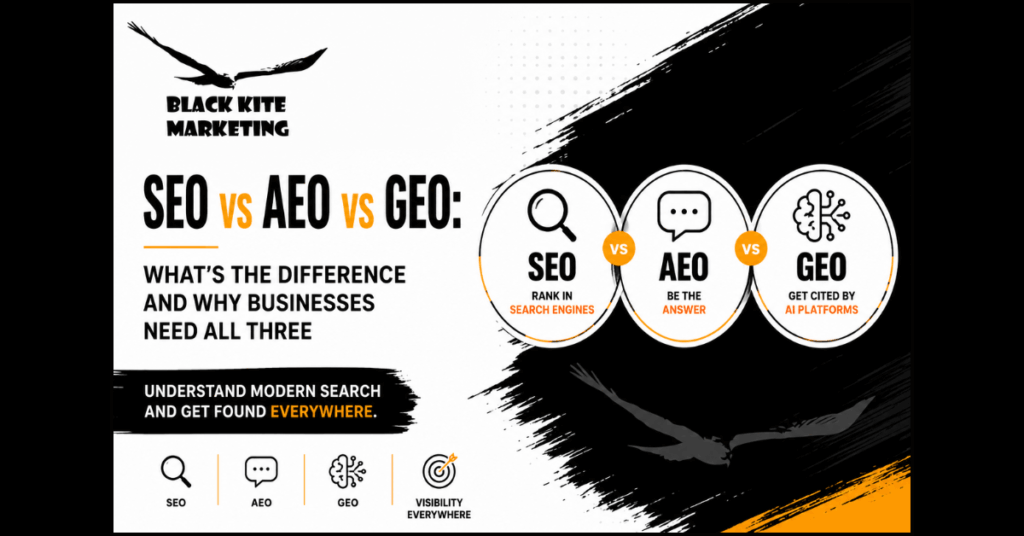
The way people search for information online is changing rapidly.
For years, businesses focused almost exclusively on Search Engine Optimization (SEO) to improve visibility in Google and drive organic traffic. While SEO remains a critical component of digital marketing, the rise of artificial intelligence has introduced new ways for people to discover information, products, and services.
Today, potential customers may search through traditional Google results, receive answers directly from Google’s AI Overviews, ask questions in ChatGPT, or use AI-powered search platforms like Perplexity and Grok. As these technologies continue to evolve, businesses need a broader strategy that goes beyond traditional rankings.
This is where Answer Engine Optimization (AEO) and Generative Engine Optimization (GEO) enter the picture.
While these terms are often presented as competing strategies, the reality is that they work together. Businesses that understand how SEO, AEO, and GEO complement one another will be best positioned to increase visibility across both search engines and AI-driven platforms.
What Is SEO?
Search Engine Optimization (SEO) is the process of improving a website’s visibility in traditional search engine results pages (SERPs). The goal is to help your website rank higher when users search for relevant keywords.
For example, if someone searches for “Long Island SEO company” or “digital marketing agency near me,” SEO helps determine which websites appear at the top of Google’s organic results.
A successful SEO strategy typically includes:
- Keyword research
- High-quality content creation
- Technical website optimization
- Internal linking
- Local SEO
- Backlink acquisition
- User experience improvements
SEO remains one of the most effective digital marketing channels because it captures users who are actively searching for solutions.
The Strengths of SEO
SEO provides several advantages for businesses:
- Long-term organic traffic
- Increased brand credibility
- Better local search visibility
- Higher-quality leads
- Sustainable marketing ROI
The Limitations of SEO
While SEO remains essential, search behavior is evolving.
More users are receiving answers directly within search results through featured snippets, AI Overviews, and voice assistants. In many cases, users no longer need to click through to a website to get the information they need.
This shift doesn’t mean SEO is becoming obsolete. It simply means businesses need additional strategies to remain visible when clicks aren’t guaranteed.
What Is AEO (Answer Engine Optimization)?
Answer Engine Optimization (AEO) focuses on helping search engines and AI-powered platforms identify and present your content as the best answer to a user’s question.
Rather than optimizing solely for rankings, AEO optimizes for answers.
Examples of answer engines include:
- Google AI Overviews
- Google Featured Snippets
- Voice search assistants
- Bing Copilot
- Perplexity AI
When a user asks:
“How much does crime scene cleanup cost?”
Google may provide a summarized answer directly within search results. AEO helps increase the likelihood that your content contributes to that answer.
Key Components of AEO
AEO focuses on making information easy for both users and machines to understand. Common tactics include:
- Answering questions directly
- Using FAQ sections
- Implementing structured data and schema markup
- Organizing content with clear headings
- Creating concise definitions and explanations
- Addressing related follow-up questions
The goal is to become the source of the answer, even when users never click through to your website.
What Is GEO (Generative Engine Optimization)?
Generative Engine Optimization (GEO) is the process of optimizing content so AI systems can discover, understand, trust, and reference it when generating responses.
While SEO focuses on rankings and AEO focuses on answers, GEO focuses on AI citations, mentions, and inclusion within AI-generated content.
Examples of generative engines include:
- ChatGPT
- Gemini
- Claude
- Perplexity
- Microsoft’s Copilot
When a user asks:
“What are the best SEO agencies on Long Island?”
An AI platform may generate a response using information gathered from numerous sources across the web. GEO helps increase the likelihood that your business, content, or expertise becomes part of that response.
Key Components of GEO
Generative Engine Optimization emphasizes:
- Topical authority
- Entity recognition
- Original research
- Digital PR and brand mentions
- Expert-driven content
- Comprehensive topic coverage
- Structured information architecture
- Consistent business information across the web
Unlike traditional SEO, GEO is less focused on specific keywords and more focused on helping AI systems understand who you are, what you do, and why your content is trustworthy.
SEO vs AEO vs GEO: Understanding the Differences
Although these strategies overlap, each serves a different purpose.
| SEO | AEO | GEO |
| Focuses on rankings | Focuses on answers | Focuses on AI citations |
| Targets search engines | Targets answer engines | Targets generative AI |
| Measures organic traffic | Measures answer visibility | Measures AI mentions |
| Relies heavily on keywords | Relies heavily on questions | Relies heavily on topical authority |
| Optimizes for SERPs | Optimizes for AI Overviews and snippets | Optimizes for ChatGPT, Gemini, Claude, and Perplexity |
The most successful businesses are not choosing one strategy over another. Instead, they are integrating all three into a unified content marketing approach.
Why SEO Still Matters in the Age of AI
One of the biggest misconceptions in digital marketing today is that AI will replace SEO.
The reality is quite different.
AEO and GEO are built on top of SEO.
Before AI systems can cite your content, your content must first be:
- Discoverable
- Crawlable
- Well-structured
- Authoritative
- Accurate
Search engines and AI models both rely on high-quality content ecosystems to understand information. Businesses that neglect foundational SEO often struggle to gain visibility in AI-driven environments as well.
Think of SEO as the foundation.
AEO builds visibility within answers.
GEO builds visibility within AI-generated conversations.
Without the foundation, the other layers become significantly less effective.
Prompt Optimization and AI Discoverability
As AI search becomes more common, businesses must also consider how people interact with AI systems.Traditional searches tend to be short:
- “SEO company Long Island”
- “digital marketing agency near me”
AI prompts are often much more conversational:
- “What is the best SEO company on Long Island for a small business?”
- “Can you recommend a marketing agency that specializes in local SEO and Google Ads?”
- “What are the differences between SEO, AEO, and GEO?”
This shift creates an opportunity for businesses to optimize content around natural language questions and real-world conversations.
Rather than focusing exclusively on keywords, content should address:
- Complete user intent
- Follow-up questions
- Contextual relationships
- Topic depth
- Conversational search patterns
Some marketers refer to this as prompt optimization.
The objective is not to optimize for specific prompts but rather to create content comprehensive enough to satisfy the wide range of questions users may ask AI systems.
Businesses that understand how customers phrase questions naturally are more likely to earn visibility across both traditional search engines and AI-powered platforms.
How to Optimize Content for SEO, AEO, and GEO Simultaneously
The good news is that you do not need three completely separate strategies.
Many of the practices that improve SEO also strengthen AEO and GEO performance.
Build Topical Authority
Create comprehensive content around your core services and areas of expertise.
Instead of publishing isolated articles, develop topic clusters that demonstrate expertise across an entire subject area.
Answer Real Questions
Incorporate question-based headings throughout your content.
Address the same questions customers ask during consultations, sales calls, and support interactions.
Use Structured Data
Schema markup helps search engines and AI systems better understand your content.
Structured data can improve visibility in rich results, featured snippets, and AI-generated responses.
Demonstrate Experience
First-hand experience, case studies, original insights, and expert opinions help establish credibility.
AI systems increasingly prioritize content that demonstrates genuine expertise.
Strengthen Entity Signals
Ensure your business information remains consistent across your website, social profiles, business directories, and third-party mentions.
Clear entity signals help AI systems confidently identify and reference your brand.
Create Citation-Worthy Content
Original data, industry research, surveys, and unique perspectives are more likely to be referenced by both journalists and AI systems.
Content that simply repeats existing information rarely stands out.
Improve Internal Linking
Connect related content throughout your website.
Strong internal linking helps search engines understand topic relationships and authority.
Optimize for Readability
AI systems favor content that is easy to interpret. Use:
- Clear headings
- Short paragraphs
- Bullet points
- Tables
- Definitions
- Logical content structure
Content that is easier for humans to read is often easier for AI systems to understand as well.
The Future of Search Is Visibility Everywhere
The goal of digital marketing is no longer limited to ranking #1 on Google.
Today’s consumers discover information through traditional search engines, AI-generated answers, voice assistants, and conversational platforms. Businesses that focus exclusively on rankings risk missing opportunities where customers are increasingly spending their time.
SEO, AEO, and GEO are not competing strategies. They are complementary approaches that work together to maximize online visibility.
- SEO helps users find your website.
- AEO helps users find your answers.
- GEO helps users find your brand within AI-generated conversations.
The businesses that will thrive in the coming years are those that understand how all three fit together and invest in creating authoritative, helpful content that serves both humans and machines.
As search continues to evolve, the companies that prioritize visibility everywhere—not just rankings—will be the ones that earn trust, attract customers, and remain competitive in an AI-driven world.