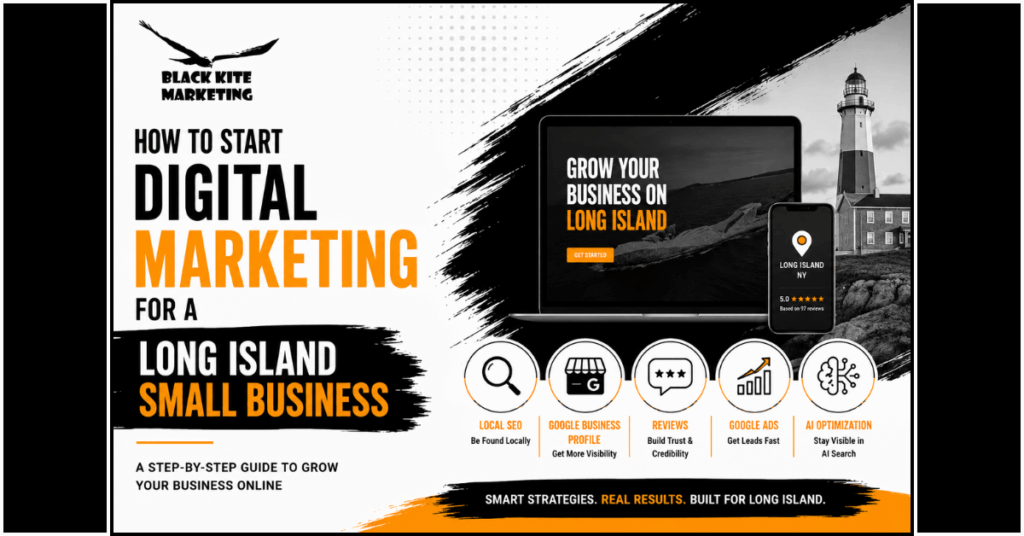
If you’re a small business owner on Long Island, you’ve probably wondered where to begin with digital marketing. Between search engines, social media, paid advertising, AI tools, and countless marketing agencies promising overnight success, it’s easy to feel overwhelmed.
The good news is that successful digital marketing doesn’t require doing everything at once. Instead, it starts with building a strong foundation that helps customers discover your business online, trust your brand, and ultimately contact you.
Whether you own a plumbing company in Suffolk County, a dental office in Nassau County, a restaurant, law firm, contractor, or retail store, this guide will walk you through the essential steps to building a successful digital marketing strategy.
What Is Digital Marketing?
Digital marketing is the process of promoting your business online to attract new customers, generate leads, and increase revenue.
Instead of relying solely on word-of-mouth or traditional advertising, digital marketing uses online channels such as:
- Search Engines (Google & Bing)
- Google Maps
- Your Website
- Search Engine Optimization (SEO)
- Google Ads
- Social Media
- Email Marketing
- Online Reviews
- AI Search Platforms like ChatGPT, Gemini, Claude, and Perplexity
Today, many customers begin their buying journey online. They search for businesses, compare reviews, ask AI assistants for recommendations, and visit websites before making a purchasing decision.
If your business isn’t visible online, you’re likely losing potential customers to competitors.
Step 1: Build a Professional Website First
Your website is your digital storefront.
No matter where customers find you—Google Search, Google Maps, Facebook, Instagram, or ChatGPT—they’ll often visit your website before contacting your business.
A quality website should include:
- Fast loading speeds
- Mobile-friendly design
- Clear navigation
- Individual service pages
- Contact information on every page
- Online forms
- Calls-to-action
- Customer testimonials
- Frequently Asked Questions
- Service area pages
- Secure HTTPS connection
A poorly designed website can significantly reduce conversion rates, even if your marketing generates plenty of traffic.
👉 Professional Web Design Services
Step 2: Should You Invest in SEO or Google Ads First?
This is one of the most common questions we receive.
The answer depends on your goals.
Choose SEO if:
- You want long-term growth.
- You want consistent leads.
- You want to build authority.
- You have patience.
- You want to reduce advertising costs over time.
SEO typically takes several months to produce meaningful results, but those results can continue generating leads long after the initial work is completed.
Choose Google Ads if:
- You need leads immediately.
- You’re launching a new business.
- You’re promoting seasonal services.
- You’re entering a competitive market.
Google Ads can produce results almost immediately but require ongoing advertising spend.
The Best Strategy
For most Long Island small businesses, the best approach is combining both:
- Google Ads generates leads today.
- SEO builds sustainable organic traffic for tomorrow.
Over time, strong SEO often reduces your dependence on paid advertising.
Step 3: Create and Optimize Your Google Business Profile
Your Google Business Profile is one of the most powerful free marketing tools available.
It helps your business appear in:
- Google Maps
- Local Search Results
- Mobile Searches
- Voice Search
- AI-powered local recommendations
A fully optimized profile should include:
- Accurate business information
- Business categories
- High-quality photos
- Service descriptions
- Service areas
- Business hours
- Website link
- Appointment link (if applicable)
- Regular Google Posts
- Questions & Answers
- Updated holiday hours
Many local searches never result in a website visit because customers contact businesses directly from Google Business Profile.
Step 4: Focus on Local SEO
If your customers are located on Long Island, your marketing strategy should prioritize local visibility.
Local SEO helps your business appear when people search for terms like:
- plumber near me
- dentist in Huntington
- roofing contractor Suffolk County
- electrician Nassau County
An effective local SEO strategy includes:
- Optimized location pages
- Consistent business information across online directories
- Local backlinks
- Google Business Profile optimization
- Local business schema
- Customer reviews
- Local content
- Internal linking
- Fast website performance
Local SEO allows your business to compete within your service area rather than against national brands.
👉 Local SEO Services on Long Island, NY
Step 5: Build Trust with Customer Reviews
Reviews influence both search rankings and customer decisions.
Potential customers often compare businesses based on:
- Number of reviews
- Average rating
- Recent reviews
- Owner responses
Encourage satisfied customers to leave reviews on:
- Yelp (where appropriate)
- Industry-specific platforms
Respond to every review professionally—even negative ones.
Reviews demonstrate trust, credibility, and real customer experience, which can also improve your visibility in AI-generated recommendations.
Step 6: Create Helpful Content
Many business owners think blogging is outdated.
In reality, helpful content remains one of the strongest ways to earn visibility in both search engines and AI-powered search.
Write articles that answer questions your customers actually ask.
Examples include:
- How much does water damage restoration cost?
- What should I do after a house fire?
- When should I replace my roof?
- Is Invisalign worth it?
- How often should my HVAC system be serviced?
Helpful educational content positions your business as an authority while attracting customers at different stages of the buying process.
Step 7: Optimize for AI Search
More consumers are asking AI assistants for recommendations instead of typing traditional Google searches.
For example:
“Who is the best digital marketing agency on Long Island?”
or
“How do I market my small business?”
To improve your visibility in AI-generated answers:
- Write conversational content.
- Answer questions directly.
- Include FAQ sections.
- Demonstrate real expertise.
- Publish original insights.
- Add structured data where appropriate.
- Keep business information consistent online.
- Build topical authority across related subjects.
- Earn mentions and citations from reputable websites.
This approach is commonly referred to as Generative Engine Optimization (GEO) or AI Optimization.
Step 8: Develop a Realistic Marketing Budget
One of the biggest mistakes small businesses make is expecting significant growth with little or no marketing investment.
While every business is different, a reasonable monthly budget often looks like this:
| Business Stage | Suggested Monthly Budget |
| Startup | $500–$1,500 |
| Growing Small Business | $1,500–$3,500 |
| Established Local Business | $3,500–$7,500+ |
How you allocate that budget depends on your goals, competition, and industry. Many businesses benefit from investing across several areas rather than putting every dollar into one tactic.
A balanced budget might include:
- Website improvements
- Local SEO
- Google Ads
- Content creation
- Google Business Profile optimization
- Review generation
- Analytics and conversion tracking
The right mix should evolve as your business grows and your marketing data reveals what delivers the best return.
Common Digital Marketing Mistakes
Many businesses waste time and money because they skip the fundamentals.
Common mistakes include:
- Building a website but never optimizing it
- Ignoring Google Business Profile
- Expecting SEO results within a few weeks
- Depending only on paid advertising
- Purchasing low-quality backlinks
- Publishing AI-generated content without editing or adding expertise
- Not asking customers for reviews
- Ignoring website speed
- Tracking rankings but not conversions
- Failing to update old content
- Using inconsistent business information across directories
- Not measuring marketing performance
Avoiding these mistakes can save both money and lost opportunities.
Frequently Asked Questions
How long does digital marketing take to work?
Google Ads can begin generating traffic shortly after campaigns launch. SEO usually takes several months to gain momentum, though the timeline depends on your industry, competition, and the quality of your website and content.
Is SEO better than Google Ads?
Neither is universally better. SEO is often a long-term investment that builds sustainable visibility, while Google Ads provides immediate exposure. Many successful businesses use both together.
How much should a small business spend on marketing?
A common guideline is to invest around 5–10% of annual revenue in marketing, adjusting higher if your business is in a growth phase or entering a competitive market. The ideal amount depends on your goals, margins, and market.
Do I need social media?
Social media can strengthen brand awareness and customer engagement, but for many local service businesses, a strong website, Google Business Profile, SEO, and reviews often drive more direct leads.
Can AI replace digital marketing?
AI can help create content, analyze data, and automate repetitive tasks, but it doesn’t replace a well-planned marketing strategy or the human expertise needed to understand customers, build trust, and make informed decisions.
Why is Google Business Profile so important?
Google Business Profile increases your chances of appearing in local search results and Google Maps, making it easier for nearby customers to find your business, read reviews, and contact you.
What is AI Optimization (GEO)?
Generative Engine Optimization (GEO) is the practice of creating clear, authoritative, and well-structured content that AI-powered search tools can easily understand and reference when answering user questions.
Final Thoughts
Getting started with digital marketing doesn’t require mastering every platform overnight. The businesses that achieve long-term success typically focus on the fundamentals: a professional website, a well-optimized Google Business Profile, local SEO, helpful content, authentic customer reviews, and a balanced mix of organic and paid marketing.
As search continues to evolve—with AI assistants becoming part of how people discover local businesses—it’s increasingly important to create content that is accurate, trustworthy, and genuinely helpful. By investing in these core areas today, your Long Island business will be better positioned to attract customers through both traditional search engines and emerging AI-driven experiences for years to come.
Contact Black Kite Marketing today and we can help you get started!